Transformation Governance
Who decides, on what evidence, and whether those decisions reach the work.

Steering committees are built to review status. CFOs and strategy officers now ask which investments changed how the business operates, and on what evidence.Transformation leaders are 9x more likely than other organizations to be mature in enterprise orchestration, the capability that connects strategy, execution and governance.KPMG International, Transforming the Enterprise (June 2026), n = 1,750
What is transformation governance?
Every transformation has a committee. It meets on a schedule, reviews status and approves plans. That is governance of the activity. Transformation governance is something more specific: deciding, on evidence, whether the operating model is changing, and making sure those decisions reach the work.
Three things make it up. Decision rights: who decides what, including at the handoffs between teams. Cadence: when decisions are made and revisited. An evidence standard: what has to be shown before a change is counted as made.
Ownership and decision authority are different things.
Why transformation governance matters
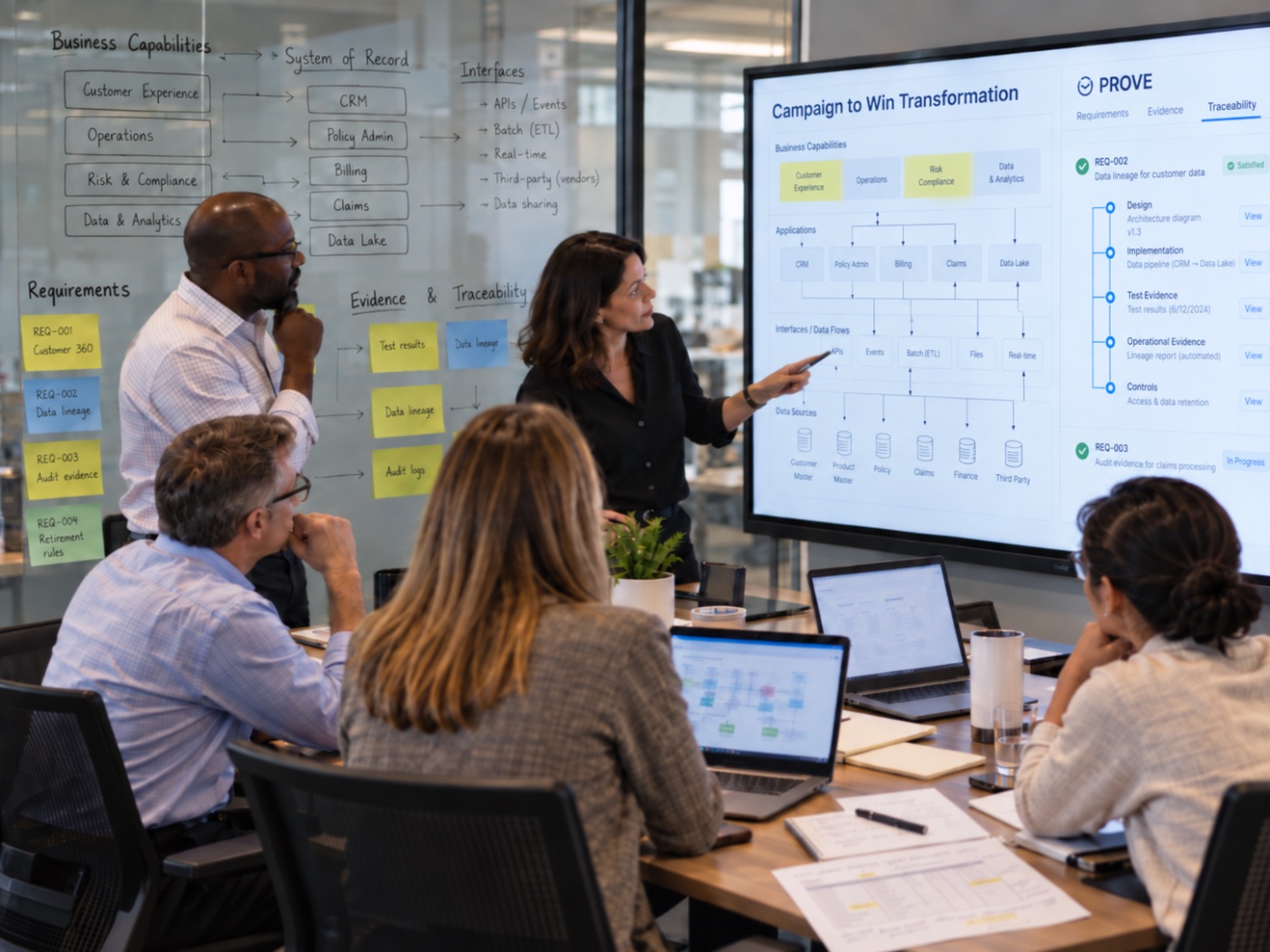
The outcome of a transformation crosses functions. The structure that governs it usually does not. That gap is where decisions get made without reaching the work, and where reported progress drifts away from operating change.
How ZBTOS approaches governance
In ZBTOS, governance is one of the five conditions in the Zero-Based Transformation™ and the last step of BRACE™ for Transformation: Establish Proof. The principle is simple.
You run the governance. ZBTOS gives you the system to run it. How decision rights are set at each seam, and what evidence counts, is taught in the Practitioner Intensive and supported through ZBTOS™ Success Support.
Learn it, apply it, then keep it accurate.
No single team owns intake, routing, delivery, proof or improvement across the enterprise. ZBTOS™ requires an enterprise function owner for each of the five: an accountability, not a new department. Naming them is a decision governance makes.
How is it different from project governance?
Project governance decides on scope, schedule, budget and risk for defined work. Transformation governance decides whether the operating model is changing, and who holds the decision where the outcome crosses teams.
Who runs transformation governance?
The enterprise does: its sponsor, transformation lead and the leaders of the flows involved. ZBTOS teaches the system and provides the instruments; your team holds the decisions.
Where does ZBTOS teach this?
The Foundation Course introduces the governance layer on a shared case. The Practitioner Intensive applies it to one of your live transformations. ZBTOS™ Success Support keeps a trained team accurate as it applies it.