ZBTOS by ETEGY
Ten questions · 5 minutesTransformation Lens Check →
Component 02 · The model

GSDPI™

Get. Sort. Do. Prove. Improve.® Five functions present in every flow of business work, read the same way across the enterprise. Five standing functions. Six ways to read them. One coordinate system.
See the GSDPI™ model →Learn to read it in the Foundation Course ›
The four componentsMethodology overview ›
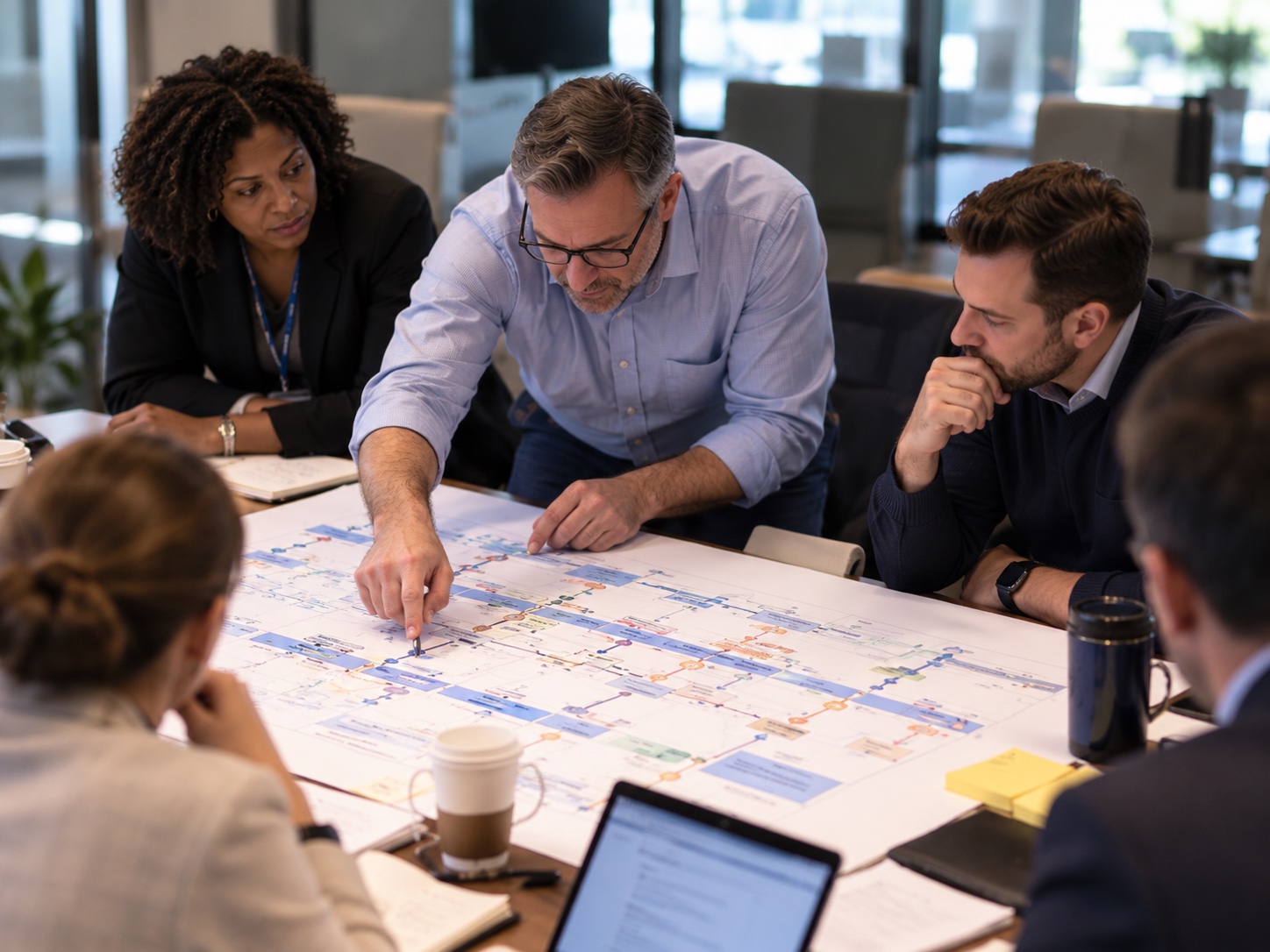
Practitioners reading a flow of business work together
Hold still.
The five functions never change order.
Move.
Business work travels through them, flow by flow.
Enabled at once.
Owning each function across the enterprise is a requirement.
The Sheet and the Stack

One flow on the sheet. Every other flow stacked behind it.

The same five hold still, move, and have to be enabled at once.
Read one part. Follow one flow. Inspect one function across the enterprise. See the whole.
GET
SORT
DO
PROVE
IMPROVE
Sales
Order received
Credit and pricing
Operations
Fulfill and deliver
Review and adjust
Finance
Invoice and collect
HR
HR’S GET
Staffing request
SORT, lit through the stack. No single team owns SORT across the enterprise. Owning it is a requirement.MACRO · EVERY FLOW TOGETHER
Dotted columns are control points: where work must survive the move from one function to the next. For example: is the commitment complete before work starts?
Many reads, one structure · six named reads
Vertical
One function, down the system.
Horizontal
One flow, across the five.
Seams
The handoffs between.
Node
One point where a function meets a lane.
Swimlane
One team’s own lifecycle.
Macro
Every flow together.

GSDPI™ reads value-producing business work: order-to-cash, hire-to-retire, procure-to-pay. A platform, an AI investment or a reorganization is an intervention within that work, never the organizing logic.

Standing functions
Standing functions, present whether or not anyone is managing them.

Every flow already takes in, routes, does, proves and improves its work. GSDPI™ names what is already there, so it can be seen, compared and owned.

Exhibit · Enterprise function owners

Your enterprise has an owner for every department, and none for the five functions that produce its value.

Inside each team, all five functions run every day. Across the enterprise, none of the five has an owner. ZBTOS™ requires one for each: an enterprise function owner who answers for whether that function is built for the fastest path to value, on its own and with the other four.

GET
Today
Marketing, sales, engineering, BU heads and IT each run part of intake.
What is missing
No one owns whether the function as a whole brings in the right work by the fastest path to value.
What its owner makes true
Pipeline, proposal, pricing and CRM logic built as one function, with every entry carrying a governed record.
No single team owns GET across the enterprise. Owning it is a requirement.
SORT
Today
IT, finance and the PMO each shape how work is routed.
What is missing
No one owns routing at the point where value is captured.
What its owner makes true
Each unit of work routed to its lowest capable, most cost-effective path, across every team.
No single team owns SORT across the enterprise. Owning it is a requirement.
DO
Today
Every team runs its own work well.
What is missing
No one owns how the work performs as one system.
What its owner makes true
Work performed so each team’s finished output arrives as the next team’s usable intake.
No single team owns DO across the enterprise. Owning it is a requirement.
PROVE
Today
Reporting, audit and finance check results after the fact.
What is missing
No one owns whether processes produce proof as they run.
What its owner makes true
The job of a process is to establish proof it was completed: every one ends in a record that links the result to its origin.
No single team owns PROVE across the enterprise. Owning it is a requirement.
IMPROVE
Today
OKRs, KPIs, scorecards and dashboards each measure a part.
What is missing
No one owns the health of the operating system itself.
What its owner makes true
A system that raises risk early, cross-checks its forecasts and keeps traceability end to end.
No single team owns IMPROVE across the enterprise. Owning it is a requirement.

An unowned function is where enablement debt collects: the records, rules and handoffs no one was accountable for building. An enterprise function owner is an accountability, not a new department. Which executive holds each one is your enterprise’s decision; the requirement is that someone does.

Finding the missing owner is practiced on the Meridian case in the Foundation Course. Defining what ownership must cover for one live transformation is the work of the Practitioner Intensive.

Why it matters

Why one coordinate system.

GSDPI™ gives every team the same five plain words for the work, at every level and in every business unit: strategic, operational and day to day. One team’s finished work is the next team’s GET, so a conversation about handoffs, seams and sequence starts in words everyone already shares.

01
Every flow can be compared.
Each flow keeps its own stage names. All of them read on the same five functions.
02
The losses sit between teams.
Handoffs between functions and lanes are where work stalls or loses its record.
03
Some functions have no owner.
Routing, proof and learning often span every team. The model makes the missing owner visible.

Evidence. Process research (APQC, 2025; van der Aalst, 2022) distinguishes documented process from process as executed. It does not independently validate GSDPI™, its five functions or six reads, which ETEGY formalized from transformation practice.

What your team learns

What your team will be able to do.

Foundation teaches it on the Meridian case, with each area applying it to its own work. The Practitioner Intensive applies it to one live transformation.

Foundation
Read a flow.
Read one flow of business work through the five functions.
Foundation
Find the seams.
Identify where work must survive a handoff between functions or lanes.
Intensive
Inspect one function across your flows.
On one live transformation, name what no single team owns.

“We had mapped the process before and thought we understood it. We didn’t. Once the work was visible, many of the political arguments lost their grip.”

Chief Transformation Officer · Industrial Services

Practitioner Intensive
Read your own flows through GSDPI™, on the transformation you are accountable for.
Explore the Practitioner Intensive →Value Streams: the Key Concept ›
ZBTOS by ETEGY

Training, assessment and support for transformation capability.

Carrying an external mandate? ETEGY →
Zero-Based Transformation™, ZBTOS™, GSDPI™, Voice of the System™ and Traceability Ratio™ are trademarks of ETEGY. Get. Sort. Do. Prove. Improve.® is a registered trademark of ETEGY. Privacy · © 2026 ETEGY