Five things executives say out loud — and every one of them has an address on the lifecycle.
Your strategy is funded — and nobody can say what has to change on the ground.
Everything is a priority, so nothing is.
The platform went live. The business works the old way.
The benefits report says green. Finance can’t reproduce the number.
Governance meets every month. Decisions don’t.
Don’t debate where it’s breaking.
Measure it.
If three of these sound like your Monday, the problem isn’t effort. Ten questions read the system that is supposed to convert strategy into governed work.
Take the ZBT Check — 5 minutes, free → Or start from what put this on your desk →Every strategy is a promise, and keeping it takes a capability most enterprises rent instead of own: seeing how the work really runs, where it breaks, and what it would take to make the strategy real — then running the change and proving the value.
ZBTOS exists so that capability stays.
It’s the operating system behind the work: the method, the lifecycle, the instruments, the assessments and the training — so your own people can read the operating model the way we do, change it the way we do, and prove it the way we do. Without a consultant in the room.
ZBTOS was built at ETEGY in the work of carrying transformation mandates. ETEGY still carries them. ZBTOS is how the clarity stays when they leave.
ZBTOS makes the capability yours. ETEGY helps you keep the promise.
Agile, project, change, process and technology methods execute defined work. The missing layer is upstream: what the strategy requires the operating model to make true, what work legitimately follows from it, and what evidence will prove the condition changed. ZBTOS governs that layer.
Required conditions, governed origin, conversion gates, evidence standards, value reconciliation.
Each of these does its job well on the work in front of it. None is accountable for whether the enterprise actually changed — which is why transformation keeps being reported rather than proven.
Three free reads, in that order. Each one answers a different question, and none of them needs a conversation first.
Every one of these is cheaper before the plan hardens than after the platform is selected. The order below is roughly the order the decisions arrive.
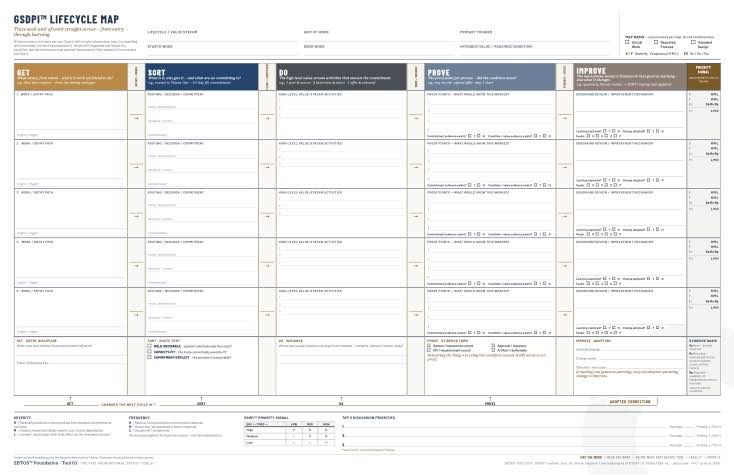
GSDPI is how business work is read inside ZBTOS. The five functions stand still; the work moves through them; and the whole path has to be enabled across functions for any of it to hold.
Where business work enters, and whether it enters governed at all.
What classifies, routes, rejects or hides the work — and what the enterprise commits to.
How execution actually happens: workflow, systems, decision rights, exceptions, handoffs.
Whether completion and value can be validated by evidence rather than narrative.
Whether evidence becomes correction — or the same failure returns under a new name.
Read down the system. Each function is a standing part of the operating model, with its own entry conditions, logic, evidence and owners — present whether or not anyone is managing it.
Read across the lifecycle. A unit of business work travels the functions in phases — and the questions worth asking are where it slows, loops, bypasses a gate, or arrives with no governed origin.
Read the whole thing at once: the cross-functional conditions, handoffs, decision rights and accountabilities that must be enabled for the system to work. This is where most transformations are actually lost.
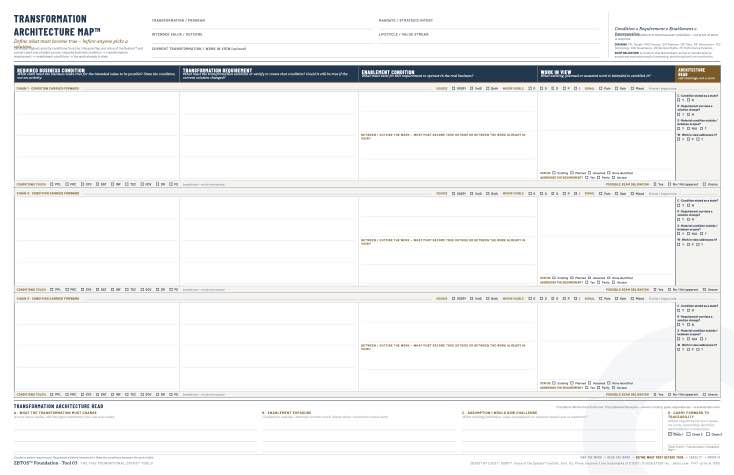
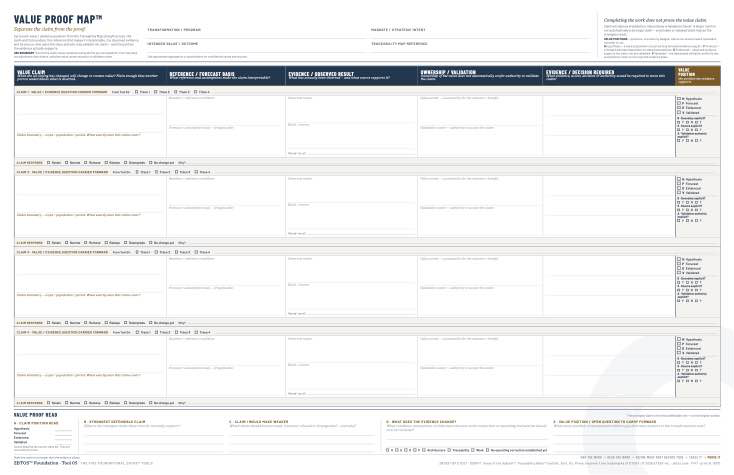
Each tool hands its answer to the next. Work them in order and the outcome isn’t five worksheets — it’s one defensible transformation agenda your executives can align on, fund and govern.
ETEGY carries board-sponsored transformation mandates on this system. Start upstream with a Diagnostic, or bring them into work already underway.