Value Streams
How value actually flows through an enterprise, from the moment a request arrives to the moment its value is proven.
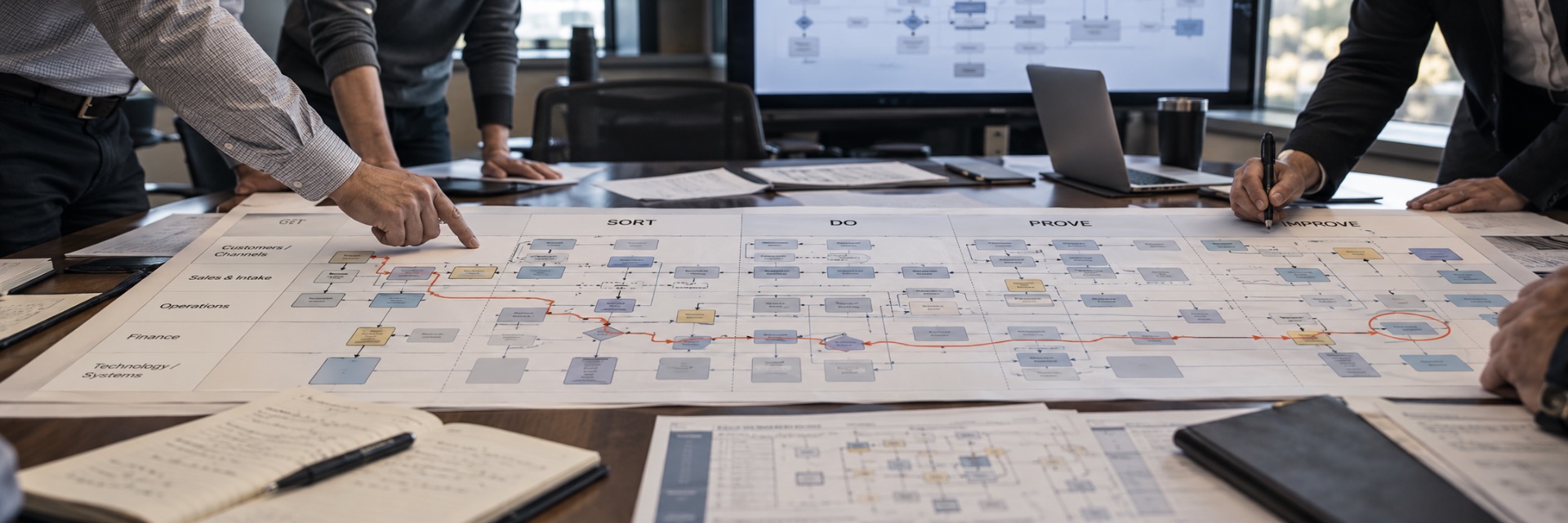
CFOs and CTOs judge a technology or AI investment by what changes end to end, not by what each team delivered. Value is usually lost in the handoffs between teams, where no single owner is looking.88% of business transformations fail to achieve their original ambitions.Bain & Company, 2024
What is a value stream?
An enterprise contains many value streams, at different levels and boundaries. Some are large and cross the whole business; others sit inside a region, a product line or a function. A customer places an order and, several teams later, cash arrives. A manager asks for a new hire and, several teams later, someone productive is in the seat. Each of these flows is a value stream.
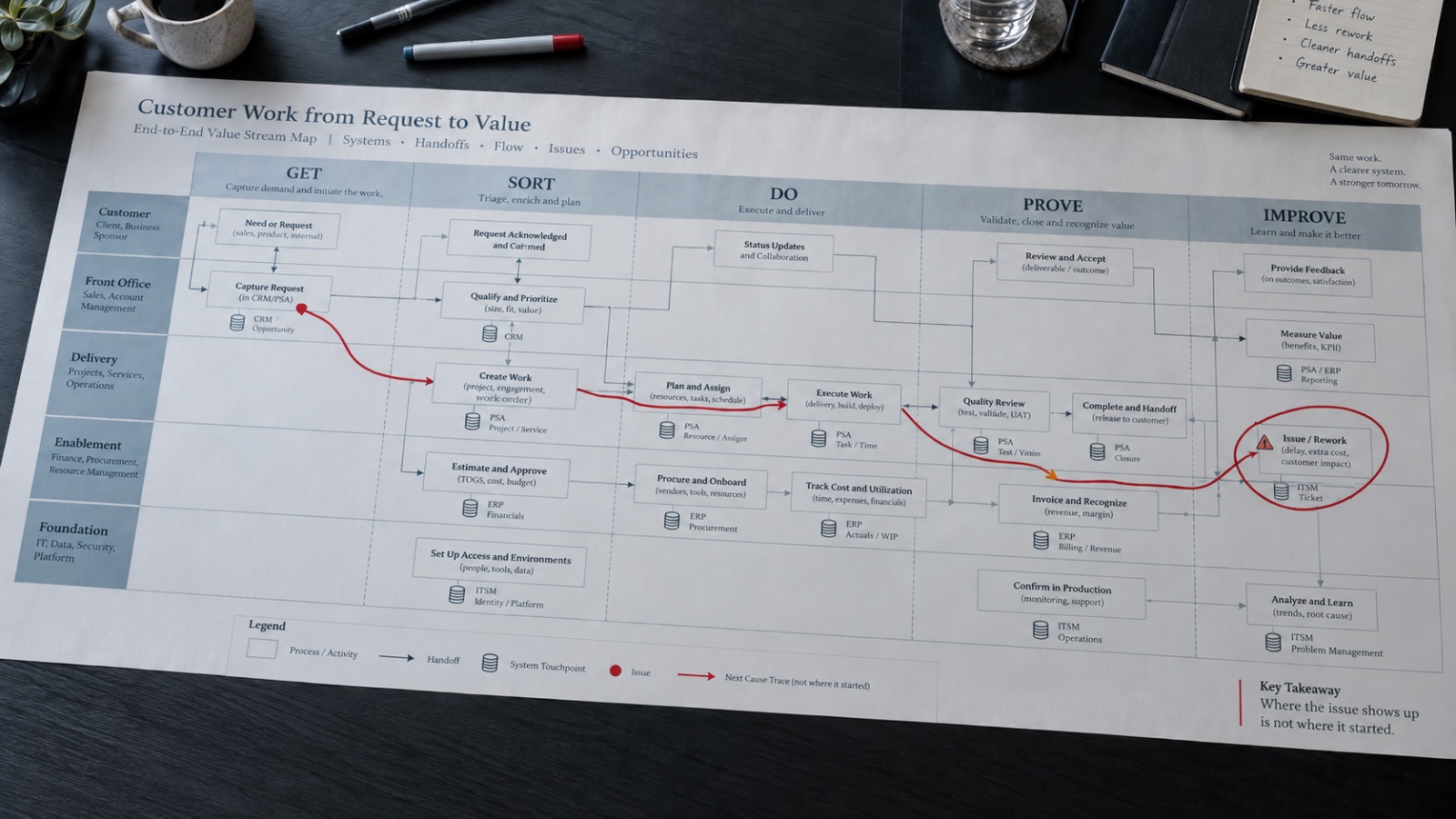
A value stream is read from end to end. It begins where a request enters the business and ends where its value is proven. In between, the work passes through sales, operations, finance, HR or IT, and through the systems each of them uses. No single team owns the whole stream. That is what makes it different from a department, a project or a process.
Transformation practitioners read value streams because the results a transformation promises are usually produced there. A new strategy, platform or structure is tested by what it changes in how work moves end to end, which is why the stream is the unit practitioners examine first.
More than a process
A process map, a workflow and a value stream describe work for different purposes. A process map shows the steps and decisions within a defined scope, which may cross several teams, so that a step can be improved. A workflow shows the sequence a piece of work follows through tasks and systems. A value stream is defined by its purpose: it follows a single request from entry to proven value, across every team, system and handoff it passes, and asks whether the value promised at the start arrived at the end.
Most of what goes wrong in a transformation happens between teams rather than inside them. Reading the stream makes those handoffs visible. Value Streams vs. Process Maps explains when to use each view.
Why value streams matter in a transformation
Budgets, targets and reporting lines are organized by function. Value is produced by streams that cross them. A transformation that is planned and measured only by function can complete every workstream and still leave each stream running as before.
Reading by value stream gives a transformation three things it cannot get any other way:
One team’s finished work is the next team’s intake. Those handoffs, called seams, are where a value stream holds or breaks.
How ZBTOS reads value streams
Different streams use different stage names and different contributors. ZBTOS examines each one through the same five diagnostic functions, called GSDPI™: Get. Sort. Do. Prove. Improve.® Each stream keeps its own vocabulary and its own shape. The functions are lenses for asking the same questions of different work, not a template the work is forced into.
How to set the boundaries of a stream, read its actual stages through the five functions, and decide where a handoff must hold are taught in the Foundation Course, on one shared case.
Read one part. Follow one flow. Inspect one function across the enterprise. See the whole.
Is a value stream the same as a process?
A process describes the steps inside one team’s part of the work. A value stream covers the whole flow across every team it passes through, and it is judged by the value produced at the end.
How many value streams does an enterprise have?
Many, at different levels. Enterprise-wide streams such as order-to-cash, hire-to-retire and procure-to-pay contain smaller streams inside regions, products and functions. Which boundary to read depends on the question being asked.
Where does ZBTOS teach value streams?
In the Foundation Course, where a cohort from across your enterprise maps a shared case on the GSDPI™ Lifecycle Map, and in the Practitioner Intensive, where a cohort maps the business flows behind one of your own live transformations.
Not ready for a course? Get the ZBTOS Briefing › New reads on value streams and the handoffs inside them.
Training, assessment and support for transformation capability.
Carrying an external mandate? ETEGY →