ZBTOS by ETEGY
Ten questions · 5 minutesTransformation Lens Check →

Benefits Realization

How delivered work becomes value the business can verify.

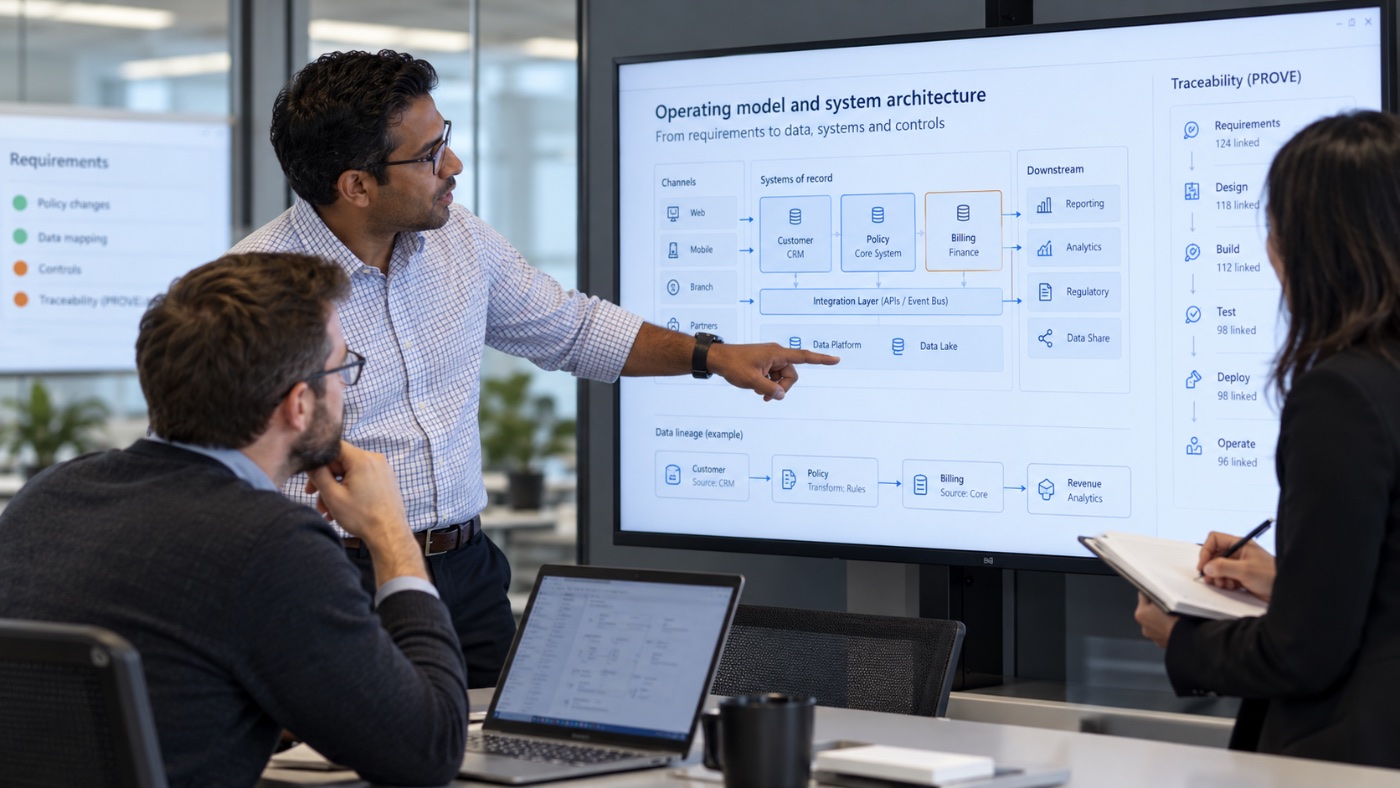
A transformation team reviewing an order-to-cash work trace
Forecast.
A projection with an assumption behind it.
Evidenced.
Supported by data from the work.
Proven.
Traced to origin; finance can reproduce it.
Exhibit · Benefits realization, read through GSDPI™
The map on the screen shows every step. It can’t show whether the benefit landed.
The team above is reviewing an order-to-cash map, and the benefit case promises faster cash. Read through the five GSDPI™ functions, the same map is missing five things that benefit depends on.
GETSORTDOPROVEIMPROVECustomerSalesDeliveryFinanceSystemsSubmit RequestAccept &ConfirmQualifyCreateOpportunityConvert toOrderPlanFulfillmentDeliverServiceClose &AnalyzeGenerateInvoicePost RevenueIntake recordCriteria fordoneCompletionrecordRequest-to-billmatchBenefit owner12345EVERY STEP IS ON THE MAP · NO ONE FUNCTION OWNS THE CORRECTION · OWNING THE ENABLEMENT IS A REQUIREMENT
GETSORTDOPROVEIMPROVECustomerSalesDeliveryFinanceSystemsSubmit RequestAccept &ConfirmQualifyCreateOpportunityConvert toOrderPlanFulfillmentDeliverServiceClose &AnalyzeGenerateInvoicePost RevenueORDER TO CASH · THE PROCESS AS MAPPED
What the GSDPI™ lens shows is missing
1GET
No intake record
Nothing counts what came in, so the benefit has no baseline to be measured against.
2SORT
No criteria for done
Orders are handed from Sales to Delivery with no agreed definition of complete.
3DO
No completion record
Service is delivered, but nothing records it in a form finance can use.
4PROVE
No request-to-bill match
The invoice isn’t matched to the original request. Work can be delivered and never billed.
5IMPROVE
No benefit owner
Close & Analyze reports results, but no one owns the benefit or feeds what is learned back to intake.
This is the map the team above is reviewing. Every step is there, and every lane has an owner. Switch views to see what it can’t show.
Learning to read a map this way, and to put the missing pieces in place before a benefit is claimed, is taught in the Foundation Course and applied to your own value stream in the Practitioner Intensive.
Download the full exhibit (PDF) →
Why it is no longer optional
The next funding decision is coming. Can you show how the strategy becomes value?

CFOs, CSOs and their peers are pressing for more than strategic ambition and progress reports. They want to know which investments will change how the business operates, where the returns will come from, and how those returns will be demonstrated. Transformation, technology, digital and AI portfolios face the same scrutiny.In PwC’s 2026 Global CEO Survey, 56% of CEOs reported no significant revenue or cost benefit from AI.PwC, 29th Global CEO Survey (2026), n = 4,454So the benefit can be proven when finance asks.

Definition

What is benefits realization?

A transformation is funded for the value it promises. Delivery produces milestones, go-lives and completed workstreams. Benefits realization is the step between the two: showing that the delivered work changed how the business runs, and that the change produced the value claimed.

Most benefits cases report one number. In practice every claim sits in an evidence state. Some are forecasts with an assumption behind them. Some are evidenced by data from the work. Some are proven, traced from origin to a result finance can reproduce. Keeping them apart is the discipline.

Delivered is not realized. Reported is not proven.

Every claim sits in an evidence state.
Forecast and evidenced
A forecast is a projection with an assumption behind it. An evidenced claim is supported by data from the work as it runs. Both are useful. Neither is proof.
Proven
Traced from its governed origin, through a change in how the work runs, to a result finance can reproduce. This is the state a CFO can act on.
A practitioner walks finance partners through a value read
Why it matters

Why benefits realization matters now

CFOs and strategy officers are reviewing transformation portfolios for what they changed and what it is worth. Capital is released against evidence of conversion. A benefits case that cannot be traced to the work does not survive that review.

1
It is how the next phase gets funded.
Finance releases capital against evidence, not against reported progress.
2
It protects the credible claims.
When every claim is one number, the weak ones discredit the strong ones.
3
It closes the loop.
A transformation that proves its value can see what worked and improve.
The ZBTOS approach

How ZBTOS traces value to the work

ZBTOS reads whether value traces back to a governed origin with the Traceability Ratio™. Its governed origin is the GET record: the moment work entered the flow. It has four states.

1:1
Got and billed.
1:0
Got, no-bill.
0:1
Side door.
0:0
Expected activity absent.

How the states are detected and scored, and how a benefits case is held in its evidence states on a live transformation, is taught in the Practitioner Intensive. The paper Counted, Not Proven develops the argument.

Where it is taught

Learn it, then apply it to your own transformation.

Why the CFO cares
Untraced work shows up in the ledger long before it shows up in the benefits case.

Work taken in but never billed is revenue leakage. Work done with no governed origin is cost no budget planned for. Both shrink the value a benefits case can defend.

PROVE, by design
The job of a process is to establish proof it was completed.

When every procedure ends in a record that proves the work was done and links it to its origin, benefits stop depending on reconstruction. That is the trail audit and compliance need, and the stability the owners of the return depend on.

Enablement debt
A benefit carrying enablement debt cannot be proven, however well it was delivered.

When the record that links the result to its origin was never built, the benefit stays a forecast. Finding that debt early is cheaper than reconstructing proof at the review.

Questions

Why can’t finance reproduce the benefits number?

Usually because the claim was counted at the program level, without a trace to the work that produced it. Finance needs origin, flow, measurement and proof.

What is the Traceability Ratio™?

A way to read whether work traces from its governed origin to its result. It has four states: 1:1 got and billed, 1:0 got, no-bill, 0:1 side door, and 0:0 expected activity absent.

Where does ZBTOS teach this?

The Foundation Course introduces evidence states and the Value Proof Map on a shared case. The Practitioner Intensive applies them to the benefits case of one of your live transformations.

Paper · free download
Counted, Not Proven: why reported value is not enough.
Download the paper (PDF) →Apply it: Practitioner Intensive ›

Not ready for a course? Get the ZBTOS Briefing › New research on which benefits hold, and why.

ZBTOS by ETEGY

Training, assessment and support for transformation capability.

Carrying an external mandate? ETEGY →
Zero-Based Transformation™, ZBTOS™, GSDPI™, Voice of the System™ and Traceability Ratio™ are trademarks of ETEGY. Get. Sort. Do. Prove. Improve.® is a registered trademark of ETEGY. Privacy · © 2026 ETEGY