ZBTOS by ETEGY
Ten questions · 5 minutesTransformation Lens Check →

Cost Transformation

Savings finance can verify, and that still hold next year.
ForCFOs and COOsTransformation leadsFinance partners
EXHIBIT 1 · FOUR SAVINGS IN ONE COST PROGRAM
Order cycle timeWork changedProven
Shared services headcountBudget line cutForecast
Contractor spendWork changedEvidenced
Travel and eventsBudget line cutForecast
A saving that rests on a changed flow of work can be proven. A saving that rests on a cut budget line is a forecast until the work changes. In one technology operating-model program, $38M claimed became $24M defensible once workstreams with no operating link were removed. Drawn from ETEGY engagements, anonymized under client confidentiality.
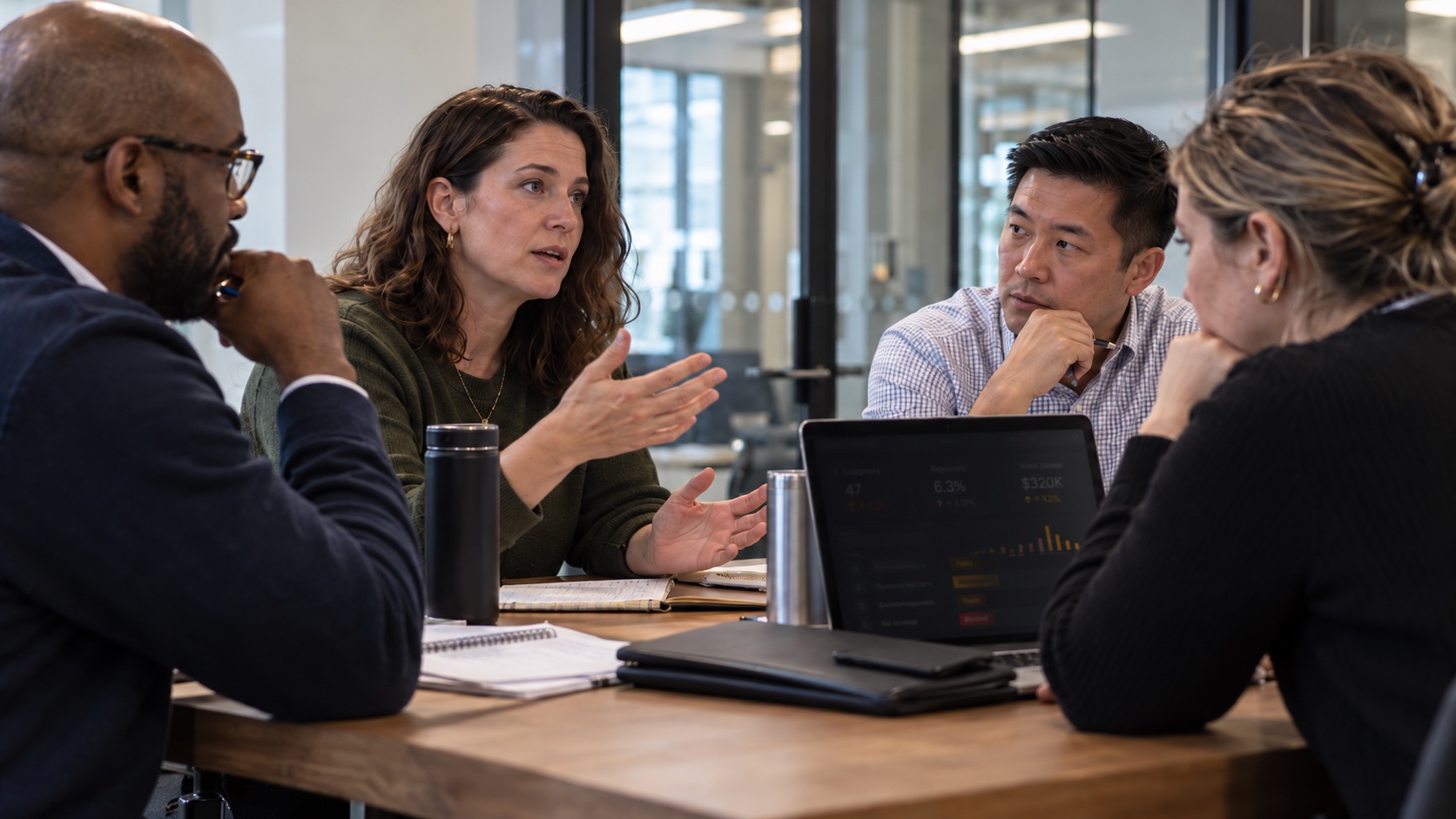
A finance and operations team discussing a cost dashboard
The problem

Cut the budget, keep the work

Most cost programs report savings against a baseline budget. CFOs and internal audit have learned to ask a second question: which change in the work produced each saving, and will it hold next year? When the answer is a cut budget line and unchanged work, the cost comes back under another name.

A saving holds when the work that generated the cost has changed.
Three questions

Ask of every claimed saving

Before a saving goes into the forecast, three questions separate the durable from the temporary.

01
Which work changed to produce it?
A flow that runs differently, or only a smaller budget.
02
Does that work trace to a governed origin?
Demand that still arrives will still be served, somewhere.
03
Is there evidence of completion?
Forecast, evidenced or proven. Keep the state visible.
How ZBTOS helps

Read the flows that generate the cost

Cost is produced by flows of work. GSDPI™ reads each flow through five functions, so a team can see where the cost arises, what the program changed, and whether the demand that drove it is still arriving.

GET
Demand and origin.
SORT
Classification and commitment.
DO
Execution and variance.
PROVE
Fulfillment and evidence.
IMPROVE
Adopted operating corrections.

Reading a cost program this way, and holding each saving in its evidence state, is taught in the Foundation Course and applied to your own program in the Practitioner Intensive.

Where it is taught

Learn it, then apply it to your own transformation.

Where cost actually sits
The largest cost question is a routing question: is each unit of work going to its lowest capable, most cost-effective path?

Shared services, offshoring, automation and AI are all answers to that question. Work that enters through the side door, with no governed origin, is cost no budget planned for.

Questions

Is this zero-based budgeting?

No. Zero-based budgeting rebuilds the budget from zero each period. Zero-Based Transformation™ starts from the work and establishes what the operating model must change. The two can run together; savings hold when the work changes.

Where does ZBTOS teach this?

The Foundation Course teaches a cohort to read the flows that generate cost and to hold each saving in its evidence state. The Practitioner Intensive applies it to your own cost program.

Stay current. New reads on cost that stays out. Published by ETEGY.

Get the ZBTOS Briefing →
ZBTOS by ETEGY

Training, assessment and support for transformation capability.

Carrying an external mandate? ETEGY →
Zero-Based Transformation™, ZBTOS™, GSDPI™, Voice of the System™ and Traceability Ratio™ are trademarks of ETEGY. Get. Sort. Do. Prove. Improve.® is a registered trademark of ETEGY. Privacy · © 2026 ETEGY